Friday, August 24, 2012

AnOrwellianPensionBoardSaysWhat?


Not "Orwellian" in the pejorative sense so much as the ... uh ... literal sense.

Pittsburgh pension board members refused Thursday to consider lowering the fund's annual investment-earnings projection, saying the move would require increased cash contributions each year that the city could fund only on the backs of employees or with a tax increase. (P-G, Joe Smydo)


Yes, but if we cannot achieve an 8% annual return (which is considerably difficult and would require luck even for aggressive private investors) then keeping future projections at 8% so we can feel better paying less now is like robbing Future Peter to pay Today Peter. One might expect Corey O'Connor to object, since it is to his administration that the brunt of this must inevitably fall.


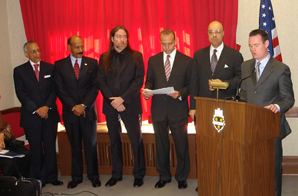
A lower investment projection would increase the city's required annual cash payments to the fund, Mr. Ravenstahl said -- and leave him scrambling to find funds in a lean budget or asking taxpayers for more money. "To me, this is where this is going, and I'm not going to do it," Mr. Ravenstahl said, noting he has never advanced a property tax increase and doesn't plan to now.

Mr. Ravenstahl's office said a change from 8 percent to 7.5 percent could require the city to pay an additional $9.3 million annually to the fund, without making a significant difference in the funded liability. (ibid)


The implications being: right now all pension funding projections you see are $9.3 million per each year into the future (compounded with interest!) lower than we are making them look on paper.* And Ravenstahl would prefer one day to be remembered as the former Mayor who helped cause some present calamity, rather than make bold choices while in office to head off that reckoning. Simply another in a very long line which we know he abhors.

Ideally, instead of cutting an already lean budget to the marrow or raising residents' wage and property taxes, the emergency which lowering projections would cause reveal might instill the political dynamic necessary to do something else entirely. To follow-through on our bluffs to share in the economic successes of our so-called non-profits, to settle upon a least-odious new revenue stream from amongst a commuter tax, tuition tax, soda tax and others, or even to monetize cherished but underperforming assets.

The revelation would actually result in several "I told you so!" moments for our Mayor -- were he only willing to let the cat out of a bag which is visibly squirming and audibly meowing.

"I don't believe 8 percent is realistic for this kind of fund. But you're right, the other side is, can we afford to lower it?" Mr. Lamb said. Because of the opposition, he withdrew his proposal for a study. (ibid)


See, there's the difference. A Patrick Dowd would have gone full Cato: climbing walls, rending his garments, pointing at graphs. UPDATE: An anonymous commentator clarifies that his motion failed for lack of a second (so it must be true).

In addition, Mr. Huss said further discussion of pension funding only leads some retirees to fear that they won't get their checks. Pension payments, he stressed, are not in jeopardy. (ibid)


I hope this was taken out-of-context. They're the pension trust fund board. What are they supposed to get together to talk about? The spread on the Cookie Cruise?

Mr. Huss accused Mr. McAneny of telling overseers, who are often in conflict with the mayor, what they wanted to hear. (ibid)

That's a little more interesting. While it remains true that all this absurdity is 80% caused by political self-preservation, there remains a 20% influence from a four-way chess game to which you and I are not privy. Some of the players evidently feel an end-game is in sight, which I suppose theoretically could moot the absolute need in the meanwhile to come up with more money for pensions. By seemingly ignoring a mathematically untenable equation, it is the shape of that end-game some seem to be preparing for -- although the casual observer wonders whether we all benefit more by sticking with checkers.

MORE: Nullspace has some. If any anonymous commentators cut and paste the body of those subscription articles into my comments section, that would be a shame.

__________
*- Aside from which, at least $287 million is contingent and non-interest-bearing. But we're doin' fine.

Thursday, August 23, 2012

Transit Funding Becomes Locally Contentious


Let me offer this opinion:

Our Mayor is probably right to be upset that even though the union was broken made selfless concessions, the stopgap public transit solution now on the table suddenly taps RAD dollars. That tax revenue was originally crafted to support cultural amenities, yet continually gets dragged further afield. Once a revenue stream is diverted it's difficult if not impossible to reverse-engineer that flow. So if Ravenstahl still "has to take a look at [the plan]," it's understandable to be approaching this in a grumpy manner.

However it would be a lot tougher for his legions of detractors to assail him had he assumed a visible leadership role in crafting solutions -- negotiating amongst workers, management, the state and voters heretofore.

Yes, transit is a state and regional issue over which City officials have no direct authority -- but what good is having a vigorous young telegenic mayor if he's not going to make a fuss over issues so critical to the city and its business climate? Education is another good example. Today's cold skepticism would be more palatable had Ravenstahl been chairing meetings, holding press conferences in Harrisburg, crashing talk shows and darting in front of webcams lo these many, many months.

At this late date Rich Fitzgerald has earned the big swivel chair on the bridge of the Enterprise. If he says "Make it so," the crew had probably better reply "Aye, Cap'n".

Friday, August 17, 2012

Voter ID Game is Transparent, More Ingenious than you have Yet Absorbed


This deal looks more jive every time we see it...

HARRISBURG - On the same day a judge cleared the way for the state's new voter identification law to take effect, the Corbett administration abandoned plans to allow voters to apply online for absentee ballots for the November election and to register online to vote. (PhillyInq, Amy Worden)

There goes the chief utility of the iPad brigades. But not to worry -- the Dept. of State's happening Facebook and Twitter accounts could still spur somebody applicable on to a Drivers License Center for questioning.

The oncoming VoterID regime will potentially be worth about how much to the Romney/Ryan Express? Three points? We are going to say between three and four points on Election Day. Assuming no earthquakes erupt at the state Supreme Court out of which a remorseful Justice Melvin crawls to do penance.

Changes to Medicare and Medicaid will be perceived more alarmingly for the older, the more infirm, more isolated and/or the more poverty stricken. Nate Silver did not fully factor in these sorts of things, such as all the affected groups and Mitt Romney's new operating system.

A real perfect storm of a sandwich that Corbett and Turzai have pulled the trigger on delivering.

Thursday, August 2, 2012

Meditations on the Police Brutality Trial of the Decade (Caution: Endless)


UPDATE: Jury reaches unanimous NOT GUILY verdict on the charge of Malicious Prosecution. Judge declares Mistrial due to jury deadlock on charges of False Arrest and Excessive Force.

All we can do is learn from this, right? Well we can't learn if we don't discuss.

The Post-Gazette shuts down its new commenting function for anything Jordan Miles related (or Jerry Sandusky related). City leaders who use Twitter and Facebook to expound on everything from parking meters to economic development to sewer upgrades are maintaining radio silence. And I don't recall seeing any opinion pieces in print since the trial started, despite cases involving political chicanery or sexual misconduct producing truckloads.

This silence is surely part of the "dynamics that are at play," too.

##

That having been written, it should be clear that not only was I not present on Tioga Street two years ago to witness the incident, but I have not been in the courtroom every day to see and hear the totality of the evidence, nor been a juror who has received the benefit of every last of the judge's instructions. The eight citizens on the jury are the best and only qualified people to decide on the merits of Mr. Miles' claims and the police officers' liability.

Nonetheless, media accounts of the trial have given us a lot to reflect upon beyond even the specifics of the incident.

##

Although the judge spoke at length about weighing "objective" evidence, defense attorneys in particular raised the importance of evaluating the "credibility" of each witness providing such evidence. This has turned out to seem particularly important because accounts of the incident are so sharply divergent.

This one is easy. Credibility is a draw. A tie. A zero-zero tie.

Brave and decorated police officers, honor-student violists with visible facial injuries, politicians, bloggers -- they're all equally capable of being faithless and self-deluding liars. That is, extraordinarily capable. People, God love them, are scum.

That's why I don't believe either story entirely -- they both make their protagonists seem way too perfect.

Mr. Miles claims he was walking in the middle of the street from his mother's to his grandmother's house, that men raced up to him in a vehicle and poured out barking insanely about guns, drugs and money, that never did any of them say, "Police!" or flash a badge, that he had no way at all to intuit who they were and what they were about, that he spun around and fell helplessly, and that his assailants instantly tackled him, raining blows before, during, and after handcuffing him, all with no conceivable cause or provocation except blood lust and prejudice.

The police officers claim they observed somebody skulking at the wall of a residence, that despite being on an undercover mission in an unmarked vehicle in plainclothes they clearly identified themselves and asked him questions before he bolted, that there was an extended foot chase during which attempts at conversation still continued, that Miles broke one policeman's hold by spinning around and elbowing the officer in the head then broke another tackle with a rearward kick to an officer's knee, that he was clearly squirming to hide a gun and apparently somehow succeeded in ditching it during the melee, that three punches to the face and a knee strike to the neck were necessary to subdue him even after he was on the ground with two officers on his back, and that nothing violent or punitive occurred after he was handcuffed.

Bollocks.

If the stakes were not so high and such consequential principles on the line, both parties would be exchanging apologies at this point and admitting they "could have handled things better in retrospect."

Instead we have competing tales of saints on earth. That's not how life works.

##

I have an alternate theory to explain Miles' attempt to flee. I wouldn't wager very much on it but it might be useful to imagine.

We know the officers stopped Miles because they were looking for hardened drug-dealing criminals in the area, suspected Miles of being a menace to society connected to a menacing network bearing contraband which must be removed from "the streets" -- or at the very least of being a desperate burglar likely to sew serious chaos. It's possible that Miles did in fact attempt to flee out of fear and guilt, though over something wildly less serious.

Maybe he had stolen $20 from him mom's purse that morning. Maybe he "borrowed" his uncle's car to go on a date, and returned it, but now assumed the temporary theft had been reported. Maybe he just drank a beer, which being 18 years of age is a crime justifying a little paranoia. Maybe he had puffed a joint that afternoon, and was afraid it was still on his breath, discovery of which would threaten his college prospects. Maybe he knew somebody who was involved in something more serious weeks or months ago, and was afraid his silence alone could get him into trouble. Maybe it involved something embarrassing involving S-E-X.

Kid stuff. Guilty-conscience stuff. Maybe, and maybe not, but grant it just for the sake of argument.

Would that mean that upon turning and running, whatever misfortune followed he had coming to him? Would it mean he effectively waived his Constitutional rights not to be stopped without reasonable suspicion, or arrested without probable cause, or physically subdued without appropriate restraint?

"Well, he ran from the police. Never, ever run from the police."

That's outstandingly good advice. It is the advice I will be giving my children, and do give to anybody who seems to require it. It's the best way to stay safe and save yourself a world of hassle and expense.

Is it law? Is it the end point of the law? Where I was raised, when you're 14 and drinking beer against the boiler cage at Frick Park near the ball field, in certain circles it was advised that if police discover you and shout, "Police! Right, what's all this then?" everybody is to run in different directions, instantly and without thinking, as swiftly as possible.

It's the wrong thing to do, yet some would argue it still doesn't merit multiple blows to the head and trumped-up charges. Even fools have civil rights.

##

Similarly, plaintiff's witness Monica Wooding gave testimony which conflicted with what police submitted in reports regarding her making "prowling" complaints and not recognizing Mr. Miles -- whereas on the stand she said Miles was a family friend she knew well, about whom she bore no complaint. Personally I find it difficult to believe that the three officers, even if they were villains, could have been foolish enough to invent witness testimony from whole cloth and then use it to prosecute someone knowing said witness would be summoned to corroborate the tale. So to remain consistent with my theory that "everybody is scum," and assuming for the sake of argument she did change her story, what does that indicate?

Maybe she witnessed the aftermath of an ugly fracas outside her window and simply wanted to avoid involvement: "I don't know him, no, he's not allowed to be here." "Sure, I'll say he was prowling, if that will get everybody off my property faster." Maybe she did know Miles, but not well; maybe at that moment surrounded by police officers Miles looked less like a wholesome friend of the family than he did in the daylight with his viola. Maybe it took daylight, and time, and Miles' family and community to arouse in Wooding a feeling that it is crucial the community hang together in this.

What does it mean that the one witness to a part of the incident came across as a little bit flaky? Only that the case gets still more difficult for the jury.

##

There have also been a set of apparent difficulties in the officers' defense. We'll only cover a portion of them.

First there is Mountain Dewgate.

It was claimed that during the melee, Jordan reached into his pocket for what officers suspected of being a gun, but turned out to be a bottle of soda. An unfortunate but supposedly reasonable error in perception during a tense, terrifying scrum.


As an observer, I feel as though when a Judge elects to crack wise at the expense of a Police Chief in such a manner, he may be trying to signal to the jury that there are serious problems with the portion of the narrative being presented.

Somehow that soda bottle has been the source of endless snares -- it was present, it was denied, it was discarded at the scene of the incident, it was fingerprinted and entered into evidence, it was not entered into evidence because it is considered "food" (which, remind me, if I ever need to murder someone, do it with a can of tuna. The perfect crime!)

However, let's assume the authorities botched the presentation of that bit of evidence. Mr. Miles is not on trial here, those charges were already dismissed. Does the fact of their scrambling to explain the absence of a bit of tangential evidence indicate that officers are guilty of false arrest, or excessive force, or malicious prosecution? No, maybe they're just guilty of making a mistake with a Mountain Dew bottle.

However, this is more troublesome:

"He probably did have a gun on him," Officer Saldutte said, prompting objections from Mr. Miles' legal team. No gun was ever found, despite a lengthy search of the snow. (P-G, Rich Lord)


At this late date -- after failing to find any weapon, after testifying that what they thought was a weapon turned out definitively to be something else, after failing to discover Mr. Miles having any criminal past or criminal connections, after the case against him was dismissed -- to continue to insist he probably had a gun strikes me as a gob smacking admission of a lack of objectivity.

##

So we have a case where neither side hit the ball out of the park, and where neither side emerged looking perfectly credible.

If you're seeking a prediction, I bet jury members will be motivated to signal their acknowledgment of the complexities, difficulties and seriousness of the case by "splitting the baby" -- guilty verdicts on some charges (perhaps just one), not guilty on others. They might even treat each officer differently.

In terms of end results, I confess it is hard not to root for the plaintiff. If the officers lose, the City both pays the damages on behalf of the individual officers and gets to blithely dismiss the results: "The Judge sucked. The jury was stupid. That trial was stupid." Nothing of consequence will change except Pittsburghers of a certain racial minority will be pleasantly shocked to learn that the system spit out a result in their favor. And so maybe some of them will grow to be more willing to engage with it, assist it, become lawyers or police officers. Contrariwise, widespread confirmation that the establishment stands reflexively against them and "insurrection" do not sound like a lot of fun.

Related to that, it is hard as a relatively powerless civilian myself not to be enthusiastic about "constitutional rights" being demonstrated to be strong, real, weighty, vibrant, multitudinous, something we can be absolutely clear that we possess and can count on as a practical matter. Even if they don't apply here, I just like to see it. That's my prejudice.

##

But let's back up. Are constitutional rights actually the most important thing in the world?

A lot of Pittsburghers will say no. Or they'll think no, and formulate a rationalization accordingly. The paramount, most important thing is that we remain mindful that we ask certain people to suit up as police officers, every single day for years, and send them into the most dangerous parts of the most dangerous neighborhoods, to infiltrate those areas under cover, seeking out conflict with the most violent and sociopathic persons that can exist in a city. Occasionally, they will find them. And we're asking their families to be okay with that.

A lot of Pittsburghers, maybe a majority, will say it's far more important as a practical and moral matter that we back up the police. If that means trusting them, or not obsessing over Mountain Dew bottles, or accepting that Constitutional rights are idealistic abstractions which cannot always remain perfectly inviolate, then it's a minuscule price to pay. We didn't make the world so imperfect, we're only trying to cope.

And there's something to that. Again, these officers are seeking out the worst of the worst. If an officer has a Jordan Miles guilty verdict in her mind, and that causes her to hesitate and consider whether that bulge in a jacket might be a Mountain Dew bottle, and it turns out to be a gun this time around, what then?

Which causes me to reflect -- why are we sending wave after wave of tiny groups of people, under cover, in unmarked cars and in plain clothes, into dangerous sections of dangerous neighborhoods to seek out dangerous people, in an environment where any rational person would be terrified, defensive and combative, night after night, in an endless struggle that would leave anybody jaded and a little twisted? Why are we making them do this? Where is all this danger coming from? Why are we at war?

##

Once upon a time, we thought about trying to ease up. We thought about attempting a very humane and rational deal: don't anybody dare pull any triggers or else consequences will be widespread and devastating, but so long as you keep it holstered, go ahead and buy, sell and possess whatever you want. Just keep it quiet and don't embarrass us. We'll stay out of it.

We'll stop sneaking around, at immense risk to ourselves and to everybody in the vicinity, hot and bothered to take money, drugs and guns off "the street" for its own sake, night after night after night. We won't go to Tioga St. unless somebody calls us there or shots ring out.

That facet of the proposed deal went under-reported for obvious reasons, but it was always part and parcel to it. It's been the linchpin of the deal in cities that have been successful in draining some of the murderous tension out of these neighborhoods.

That deal never got very far in Pittsburgh. It wasn't the community that rejected it, it wasn't the drug dealers, it wasn't the political leaders or even the criminal prosecutors who rejected it. The story of who rejected it has gone gravely under-reported as well.

We've got to cut it out. We've got to stop pitting our police officers against poor and desperate citizens in the dead of night for little or no good reason. We've got to stop making ourselves sick and crazy.

Friday, July 27, 2012

City Schools: Not an Encouraging Portrait at the Present Moment


As 280 School District employees are laid off on the exclusive basis of seniority even acknowledging some pretty fierce achievement gaps and challenges, and it is confirmed that the District's push to close a diverse and successful high school was built largely on false pretenses, residents in at least one predominantly African-American neighborhood are tearing their hair out.

Thursday, July 26, 2012

Judges Tear Up Gov. Corbett's "One Size Fits All" Drilling Law


Score another one for local zoning codes and for the Judicial branch:

The majority opinion states that requiring municipalities to change their zoning rules in a way that would conflict with their development plans "violates substantive due process because it does not protect the interests of neighboring property owners from harm, alters the character of neighborhoods and makes irrational classifications – irrational because it requires municipalities to allow all zones, drilling operations and impoundments, gas compressor stations, storage and use of explosives in all zoning districts, and applies industrial criteria to restrictions on height of structures, screening and fencing, lighting and noise." (P-G Pipeline, Laura Olson)


Current Facebook status of Briget and Doug Shields: "One small step in the right direction for the people of PA."